By Abdul Rahman M. Baig
Mina – The Indian consulate along with the Hajj Mission in Jeddah has significantly enhanced its reception and transit operations for Hajj 2026 through extensive logistical upgrades, including the introduction of high-speed train connectivity and baggage-free travel facilities for pilgrims.
The new measures have considerably reduced waiting times and improved the overall travel experience for more than 1.75 lakh Indian pilgrims undertaking the annual Hajj pilgrimage this year.
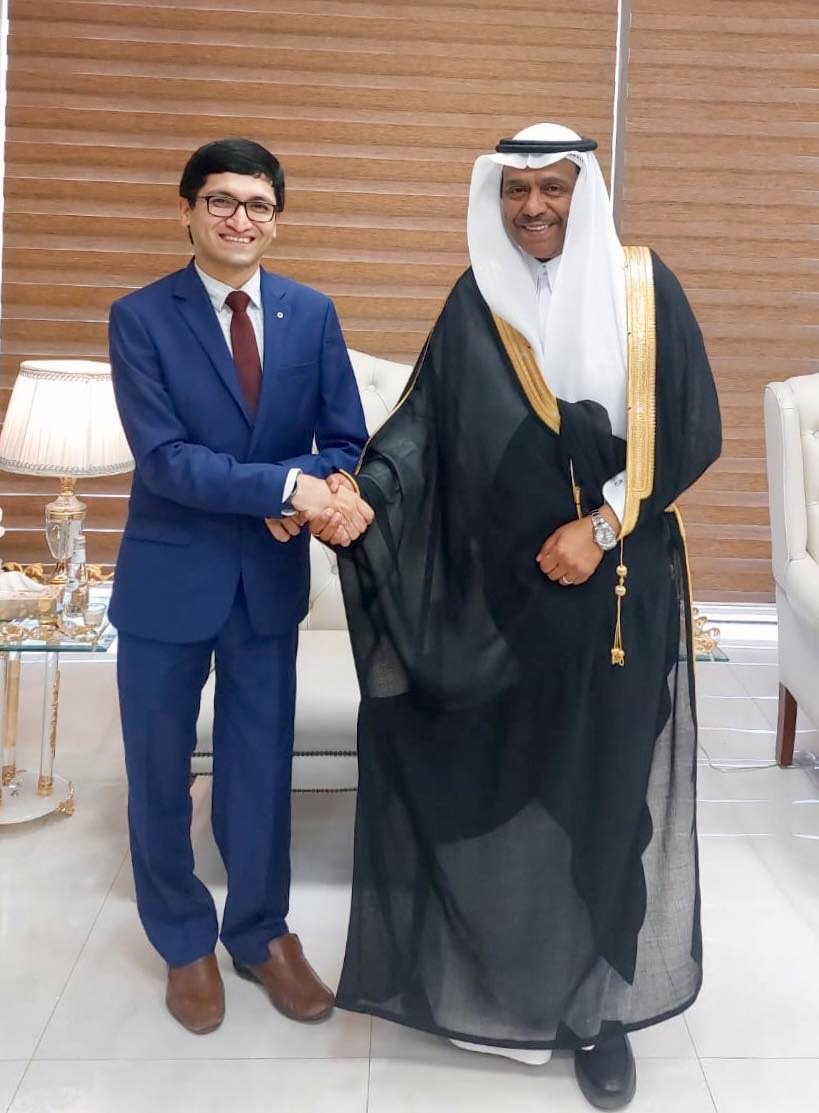
Speaking from the tent city of Mina, Fahad Ahmed Suri highlighted the extensive groundwork and coordinated efforts undertaken by the Indian Hajj Mission to manage the large-scale operations efficiently.
“We have an elaborate setup for every arrival. During the pre-core Hajj period, we welcomed 122,518 pilgrims from the Hajj Committee of India through 422 flights,” Suri said.
According to him, around 51,000 pilgrims arrived in Madina, while the remaining pilgrims entered Saudi Arabia through Jeddah.
He further stated that every stage of the operation was meticulously coordinated with airport authorities, airlines, baggage handling teams, and Indian ground support staff to ensure smooth movement and timely transit of pilgrims.
The Indian Hajj Mission’s enhanced logistical planning and round-the-clock administrative arrangements have played a crucial role in facilitating seamless travel and accommodation for Indian pilgrims during one of the world’s largest annual religious gatherings.
Highlighting major logistical reforms introduced to enhance pilgrim convenience, Fahad Ahmed Suri said the Indian Consulate in Jeddah has, for the first time, incorporated Saudi Arabia’s high-speed rail network into its Hajj transit operations.
“This is the first year where we are transporting our pilgrims via high-speed train. Fifty per cent of our pilgrims travelling between Madina and Makkah are using the high-speed train facilities, which has significantly improved transportation convenience,” Suri stated.
In another major initiative aimed at reducing airport congestion and easing pilgrim movement, the Indian Hajj Mission introduced a “baggage-free movement” system this year.
Under the arrangement, pilgrims arriving in Saudi Arabia are transported directly to their accommodation in Makkah or Madina without waiting for their luggage at airport baggage carousels. Their baggage is separately transported and delivered to their respective residences.
“Our pilgrims move seamlessly to their accommodation places, whether in Madina or Makkah, while their baggage is transported separately and efficiently. So far, we have handled nearly a quarter of a million baggage pieces belonging to Indian Hajj pilgrims and ensured their careful delivery to the designated accommodations,” Suri added.
The new initiatives are being viewed as a major step towards improving comfort, efficiency, and overall travel experience for Indian pilgrims during Hajj 2026.
Fahad Ahmed Suri credited the successful execution of the large-scale logistical arrangements for Indian Hajj pilgrims to close coordination between the Indian Hajj Mission and various Saudi government departments, particularly the Ministry of Hajj and Umrah.
He stated that continuous real-time cooperation with Saudi authorities played a key role in ensuring smooth management of pilgrim arrivals, transit, accommodation, and visa processing during Hajj 2026.
Suri further revealed that the Indian mission successfully prevented any loss of India’s allocated Hajj quota of 175,025 pilgrims — comprising 122,518 seats under the Hajj Committee of India and 52,507 under private tour operators — despite several last-minute cancellations.
“Due to unforeseen situations, many pilgrims were unable to travel. We worked very closely with the Saudi Ministry of Hajj and Umrah to ensure that none of India’s allocated seats went vacant. Those seats were immediately reassigned to pilgrims from the waiting list of the Hajj Committee of India, and replacement visas were issued at very short notice,” he said.
He also praised the efficiency of the digital visa processing system, which enabled authorities to complete the replacements swiftly and without disruption.
As pilgrims completed their movement into Mina on the eighth day of the Islamic month before proceeding to the plains of Arafat, Suri urged Indian pilgrims to focus entirely on their spiritual journey and leave all logistical concerns to the Indian Hajj Mission.
“Our advice to pilgrims is not to worry about logistical matters and instead concentrate on performing their Hajj peacefully while taking care of their health and well-being. From the moment they leave India, they should trust the systems and services put in place by the Indian Hajj Mission to support them throughout the pilgrimage,” he stated.
Suri concluded by noting that the scale of coordination and logistical cooperation witnessed during Hajj reflects the growing strength of strategic relations between India and Saudi Arabia.
Emphasising the importance of bilateral ties, Fahad Ahmed Suri described Saudi Arabia as a key strategic partner for India, highlighting the strong people-to-people relationship between the two nations.
“Saudi Arabia is an important country for India and forms part of our extended neighbourhood. One of the strongest pillars of this relationship is the people-to-people connection. Around 2.7 million Indians reside in the Kingdom, including nearly 1.2 million in the western region where most Hajj rituals are performed. Our cooperation in the Hajj ecosystem reflects the depth of the broader bilateral relationship,” Suri stated.
The Consul General noted that the extensive coordination witnessed during Hajj operations demonstrates the growing strategic partnership and mutual cooperation between India and Saudi Arabia across multiple sectors.
Hajj is an annual Islamic pilgrimage undertaken by millions of Muslims to the holy city of Mecca in Saudi Arabia. It is regarded as one of the Five Pillars of Islam and is considered a mandatory religious duty for every Muslim who is physically and financially capable of performing it at least once in their lifetime.