J.S. Ifthekhar
Hyderabad: Most of us are accustomed to hearing the Quran explained in the hallowed precincts of a mosque, where scholars expound its verses with the aid of traditional commentaries and classical texts. Rarely does Quranic exegesis become a visual experience, presented not from a pulpit but through a PowerPoint presentation (PPT).
But these are unusual times, the age of AI.
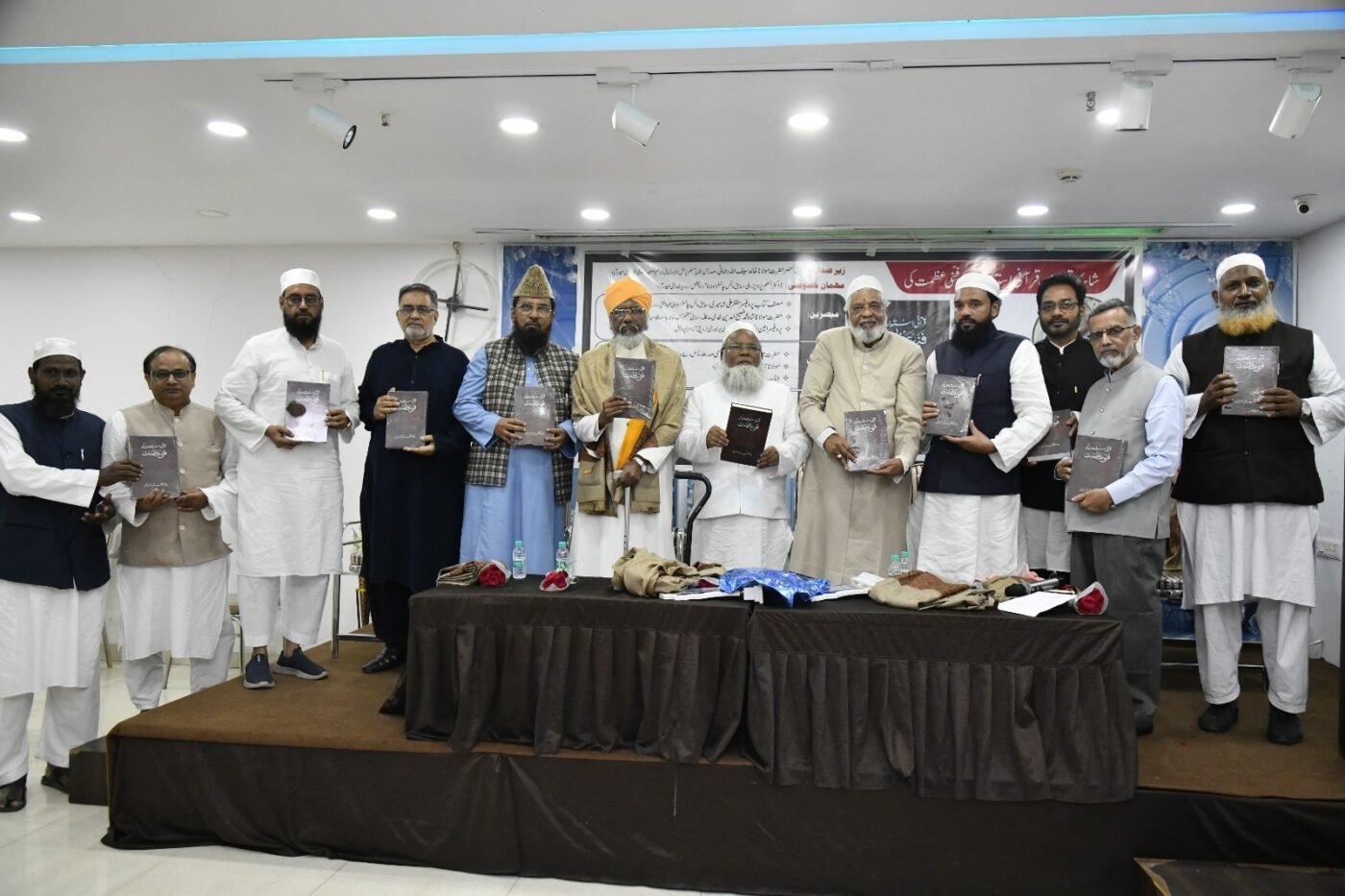
The other day, Prof. Muzaffar Shahmiri, former Vice-Chancellor of Moulvi Abdul Haq Urdu University, Kurnool, turned a book-release function into something resembling a classroom. With a series of beautifully designed slides, he took his audience on an absorbing journey through the metaphors of the Quran, illuminating its linguistic elegance, literary devices and extraordinary expressive power.
The occasion was the release of his scholarly work, Qurani Iste’aron Ki Fanni Azmat (The Elegance of Quranic Metaphor), the product of nearly two decades of painstaking research.
Prof. Shahmiri has identified, classified and explained 157 Quranic metaphors—an area that, he points out, has received little systematic attention in Urdu. Apart from the pioneering work of the celebrated theologian, linguist and exegete Al-Zamakhshari, comparable work on the subject has been scarce.
What makes Prof. Shahmiri’s achievement even more remarkable is that his primary discipline is Urdu literature. He is neither a madrasa-trained scholar nor a Mufti or an Aalim. Indeed, some people tried to dissuade him from undertaking a subject as demanding and specialised as the linguistic analysis of the Quran. But he persisted.
The result is a work that seeks to bring together the sensibilities of a literary scholar and the discipline of a researcher.
Allama Iqbal had urged the Muslim to dive deep into the Quran and discover new dimensions of its meaning:
Quran mein ho ghota-zan ae Mard-e-Musalman
Allah kare tujh ko ata jiddat-e-kirdar
Prof. Shahmiri appears to have taken Iqbal’s exhortation literally. He plunged into the Quranic text and emerged with a fascinating exploration of its metaphorical language.
As he explained his findings during the presentation, the audience listened intently. Among those present was Maulana Khalid Saifullah Rahmani, President of the All India Muslim Personal Law Board. At several points, scholars in the audience could be heard responding with an appreciative “SubhanAllah”.
For Prof. Shahmiri, however, the metaphors of the Quran are not merely ornamental devices employed to embellish language. They are powerful instruments of communication, enabling profound and often abstract truths to be conveyed through familiar images.
He has classified the metaphors into 13 categories, documenting their occurrence in the Quran. These include Iste’ara Bittasreeh (17), Iste’ara Bil Kinaya (8), Iste’ara Wafaqiya (5), Iste’ara Inadiya (5), Iste’ara Murashshaha (5), Iste’ara Gharibah(3), Iste’ara Hissiya (9), Iste’ara Aqliya (3), Iste’ara Hissi Tarfain (2), Iste’ara Hissi Mujarradah (1), Iste’ara Hissi Murashshahah (26), Iste’ara Tamthiliya (27) and Iste’ara Tabaiya(46).
The terminology may sound forbidding to the uninitiated, but Prof. Shahmiri’s approach is anything but inaccessible. His central argument is simple: the Quran frequently gives physical form to abstract spiritual realities, allowing the human mind to grasp ideas that might otherwise remain beyond its immediate comprehension.
Light (noor), for instance, becomes a metaphor for divine guidance, while darkness (zulmaat) represents deviation from the right path. The imagery is immediate and universal. One does not need to belong to a particular culture or speak a particular language to understand the difference between light and darkness.
This universality is one of the central conclusions of Prof. Shahmiri’s research. Quranic metaphors, he argues, are aafaqi — universal in their appeal. They are not confined to a particular geographical landscape, language or cultural tradition.
The Quran speaks of light, darkness, the straight path, a rope, disease, clothing and many other familiar things. Yet these ordinary objects are invested with extraordinary spiritual meanings.
Prof. Shahmiri’s presentation made this point particularly vivid.
Using carefully designed visuals, he explained the Quranic reference to the creation of the human being in the womb, surrounded by “three layers of darkness”. Another slide illustrated the Quranic expression concerning giving Allah a “goodly loan”, while yet another brought alive the verse: “Heaven He raised and imposed the balance.”
But perhaps the most striking visual representation was inspired by the Quran’s recurring admonition to those who refuse to reflect upon its verses: “Are their hearts locked up?”
On the screen appeared a heart caught in a padlock.
The image was simple, almost startlingly so, but it conveyed the metaphor instantly. What could have required several minutes of explanation was communicated in a single visual frame.
Another example was the Quranic use of the word maraz — disease—not merely in its physical sense but to describe spiritual ailments such as pride, envy, hatred, deceit and disobedience. Just as physical disease weakens the body, these moral diseases corrode the human soul.
It was perhaps this ability of the Quran to transform the familiar into the profound that first drew Prof. Shahmiri towards the subject.
The turning point came in 1992. He was reading Tarjuman-ul-Quran, the celebrated commentary of Maulana Abul Kalam Azad, when a verse from Surah Al-Kahf caught his attention:
Fadarabnaa ‘alaa aazaanihim fil kahfi seneena ‘adadaa.
“We struck their ears in the Cave for a number of years.”
The word fadarabnaa intrigued him. Different translators had rendered it as “covered”, “sealed” or “closed”. But the literal meaning of the Arabic word is “struck”.
Why, he wondered, had the Quran used the word “struck” in this context?
That question opened an entirely new avenue of inquiry.
“That insight drew my attention to Quranic metaphors which often transcend dictionary meaning,” Prof. Shahmiri recalled.
From that moment began a journey that would continue for almost two decades.
The book that emerged from this journey is scholarly without being forbidding. Prof. Shahmiri’s long experience as a teacher is evident in the manner in which he explains complex linguistic concepts. His prose is refined but accessible; his exposition is analytical but instructional.
Prof. Syed Aminullah of S.V. University, Tirupati, perhaps captured this quality best when he observed that the distinctive feature of the book is that “throughout the course of reading, one feels as though he is constantly in the company of the author.”
That sense of companionship is important because the subject itself can easily become technical. The science of metaphor, particularly within the Arabic rhetorical tradition, has its own terminology and classifications. Prof. Shahmiri, however, attempts to take the reader by the hand rather than leave him lost in a maze of terminology.
Maulana Khalid Saifullah Rahmani, while appreciating the magnitude of the work, pointed to another important aspect of Prof. Shahmiri’s contribution. There has been relatively little systematic work in Urdu on the linguistic analysis of Quranic expressions and the use of figurative speech in the Quran. Qurani Iste’aron Ki Fanni Azmat, he said, fills a long-felt need.
He illustrated the beauty of Quranic metaphor with the word libas—clothing—used in Surah Al-Baqarah to describe the relationship between husband and wife.
The metaphor is extraordinarily intimate. Clothing covers the body, protects it, provides comfort and warmth, conceals imperfections and remains in close physical proximity. By describing spouses as “garments” for one another, the Quran captures in a single word the intimacy, privacy, emotional comfort and mutual protection that define marriage.
It is precisely such instances that Prof. Shahmiri has sought to uncover and explain.
His work demonstrates that Quranic metaphors are not decorative embellishments added to an otherwise straightforward text. They are integral to the Quran’s method of communicating with the human mind and heart. They compress layers of meaning into familiar images and invite the reader not merely to read but to reflect.
Perhaps that is why the book’s presentation was more than a conventional literary event. With the help of technology, Prof. Shahmiri transformed centuries-old rhetorical devices into visual experiences for a contemporary audience.
The mosque, the classroom and the digital screen came together in an unusual setting.
And in doing so, the presentation served as a reminder that the Quran’s language continues to speak across centuries — not merely through its words, but through the images those words summon in the human imagination.
For a scholar who began his journey with a single puzzling word in a verse from Surah Al-Kahf, the destination is an impressive one: 157 metaphors, 13 categories and nearly two decades of research.
More importantly, it is an invitation to look at the Quran anew—not simply as a text to be recited or interpreted, but as a work of extraordinary linguistic and literary richness whose metaphors continue to reveal fresh dimensions to those willing to pause, ponder and look beneath the surface.