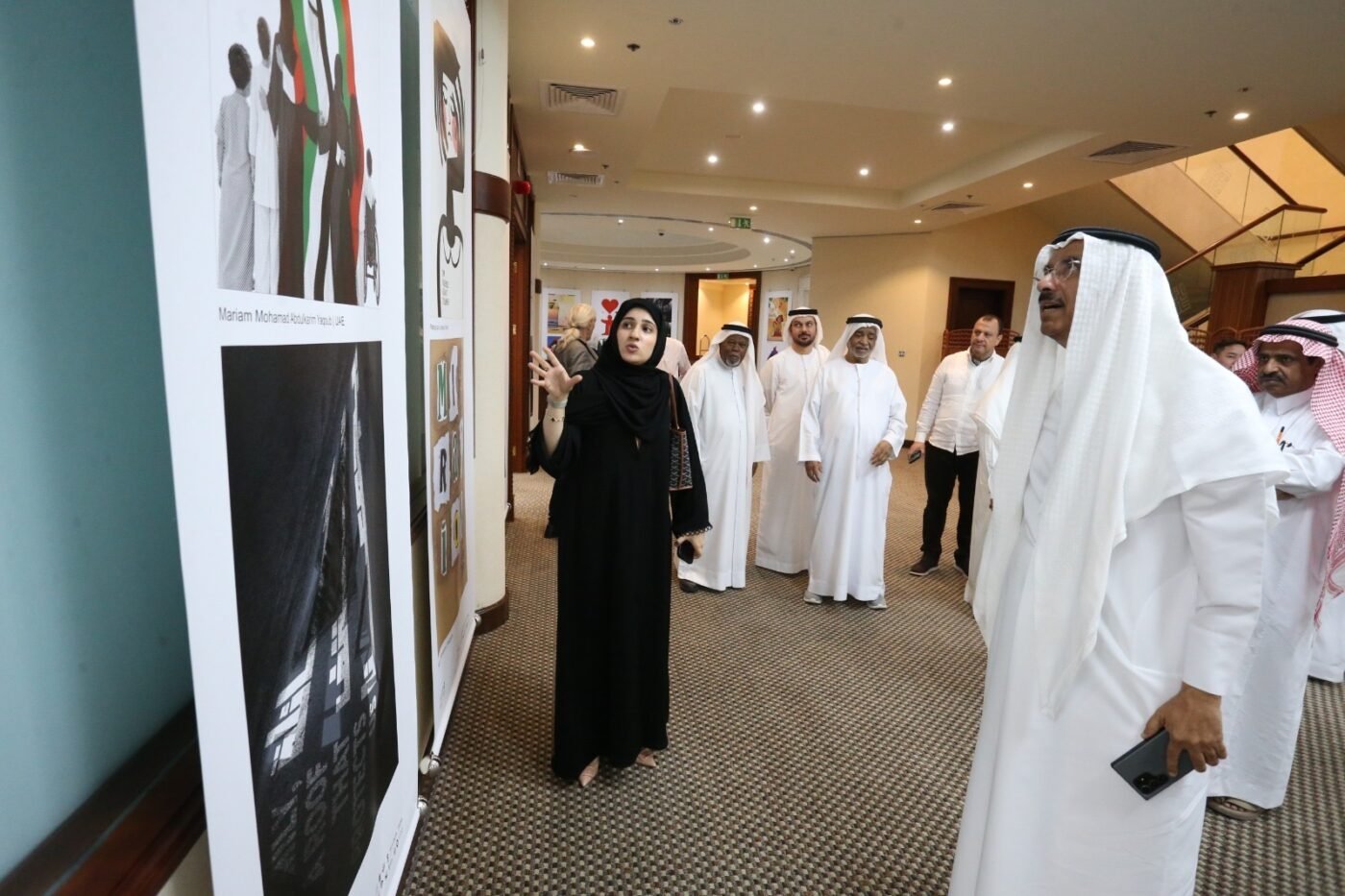
Mohammed Ahmed Al Mur, Chairman of the Library at the Cultural and Scientific Association in Dubai, opened the 8th Emirates International Poster Festival, held under the theme “One Family, Many Stories” to coincide with the UAE’s Year of the Family and exhibiting 377 works selected by an international jury of 17 members from 14 countries across four continents from 1,937 submissions received from 55 countries.
The exhibition brings the selected works together in a single space at the Cultural and Scientific Association in Dubai, presenting the diversity of visual approaches through which designers have addressed the theme of family. The works range across experimental typography, material expression, conceptual metaphor, abstraction, collage and culturally situated communication, in a diversity that reflects the breadth of the contemporary poster design landscape.
The exhibition includes works by legendary figures in poster design, among them Paula Scher (USA), Rosmarie Tissi (Switzerland), Agnieszka Ziemiszewska (Poland), Lyuba Tomova (Bulgaria), Annette Lenz (France), Kapka Kaneva (Bulgaria) and Gitte Kath (Denmark), alongside a large number of other designers. Their work is being shown in the UAE and the wider region for the first time, within the special exhibition “Women and the Poster,” hosted by the International Triennial of Stage Poster in Sofia as Guest of Honour.
Student participation accounts for 33 per cent of total submissions this year, reflecting the festival’s educational role alongside its role as an exhibition platform, a role reinforced by the active participation of local universities, foremost among them the American University in the Emirates.
Al Mur cited the words of President Sheikh Mohamed bin Zayed Al Nahyan, “Family is the cornerstone of society and the foundation of the nation’s prosperity and progress,” and of Sheikh Mohammed bin Rashid Al Maktoum, Vice President and Prime Minister: “In the UAE, we are all one big family whose wellbeing stems from the stability and happiness of every individual,” affirming that these words are not slogans but a philosophy guiding the work.
“The Year of the Family is a national commitment, and the festival translates that commitment into a global visual conversation,” Al Mur said. “Through the poster, a medium that transcends languages and borders, we celebrate what unites humanity while preserving the diversity of its stories.” He added: “In the Year of the Family, this edition reminds us that difference does not divide us; it can form the basis for a richer and deeper dialogue,” noting that the scale of participation and the rigour of the selection embody the festival’s standing in the international poster design landscape.
Dr. Arafat Al-Naim, curator and director of the 8th Emirates International Poster Festival and Dean of the College of Design at the American University in the Emirates, said the quality of the 377 selected works, not merely the volume of submissions, is what distinguishes this edition.
“The jury reviewed 1,937 works from 55 countries, and what distinguishes this exhibition is the standard of what passed that stage,” Al-Naim said. “The selected works are not illustrations of a theme, but complete design works in which concept, form and material are precisely balanced. Each one earns its place on the wall.”
He said the works go beyond the easy route of depicting family through familiar symbols: “The letter becomes an image, texture evokes memory, abstraction establishes relationships without depicting people, and collage reconfigures fragments into new meanings. The strength of this edition lies in each designer’s awareness of their means, and in how little is wasted.”
Citing Milton Glaser’s observation that “a great poster brings together brain and heart,” Al-Naim said the selected works achieve that union: “They do not offer a single definition of family, but open a space for visions that intersect and diverge, expressing memories, identities and relationships that vary from one culture to another, with economy of means, clarity and emotional force.”
He added that the international jury was keen to judge across multiple cultural contexts rather than through a single lens: “The result is an exhibition that is rigorous in its standard and genuinely plural in voice.”
On artificial intelligence possibilities, he said: “AI tools expand the designer’s, but they do not determine the value of a poster. What matters more are the designer’s decisions, the coherence of the concept, and critical and ethical professional commitment.”
Bilal Al-Badour, Chairman of the Cultural and Scientific Association, said the Association takes pride in the festival’s international presence and its role in consolidating the country’s position as a center of creativity and creativity, adding: “The breadth of international participation and the diversity of partnerships are a source of pride for the Association, and reflect the festival’s role in connecting design communities and creating opportunities for intercultural interaction through a visual language that transcends geographical dialogue and linguistic boundaries.”
Al-Badour commended the efforts of the designers, artists, jury, festivals, academic institutions and international partners, looking forward to “continuing to strengthen the festival as a platform that brings together creativity and knowledge, diversity and dialogue, and individual visions with shared human values.”
The festival’s academic partnerships reflect the growing role of UAE institutions in nurturing design talent. The American University in the Emirates, through its College of Design, has taken an active part in supporting the festival and empowering emerging designers, providing a platform for students to exhibit alongside established international names and strengthening the bridge between academic training and professional practice. The university’s participation is part of a wider network of academic partners including Cyprus University of Technology, Istanbul University-Cerrahpasa and the Polish-Japanese Academy of Information Technology, alongside contributions associated with the International Fine Arts, Printing and Sustainability Congress.
The 8th edition jury includes Evripides Zantides (Cyprus), Peter Bankov (Belarus–Czechia), Najat Makki (UAE), Agnieszka Ziemiszewska (Poland), Hajime Tsushima (Japan), Chang Kim (South Korea–USA), Keizo Matsui (Japan), Li Zhang (USA), Thiago Lacaz (Brazil), Radoslava Boor (Bulgaria–Czechia), Chang Fang Pang (Taiwan), Goo-Ryong Kang (South Korea), Renato Tagli (Switzerland), Mohamed Zakaria Soltan (Egypt), Lia Vilahur Chiaraviglio (Spain) and William Harald-Wong (Malaysia). Its composition, spanning pioneering Emirati artists, members of the Alliance Graphique Internationale, poster award winners and academic professors, reflects the festival’s ambition to judge across multiple cultural contexts rather than according to a single design tradition.
Partners include the Cyprus Poster Triennial, Osaka Poster Festival, Prishtina Poster Festival, Worldwide Graphic Designers, the Type & Text platform, The Design Alliance Asia, Design India, the Korean Society of Basic Design & Art, the Taiwan Poster Design Association, the International Design Education Expo and Conference, and Poster Platform.
The Emirates International Poster Festival has established itself as one of the world’s leading platforms for poster design, challenging designers with social themes and visual demands that push the boundaries of the medium and inspire emerging generations of designers.