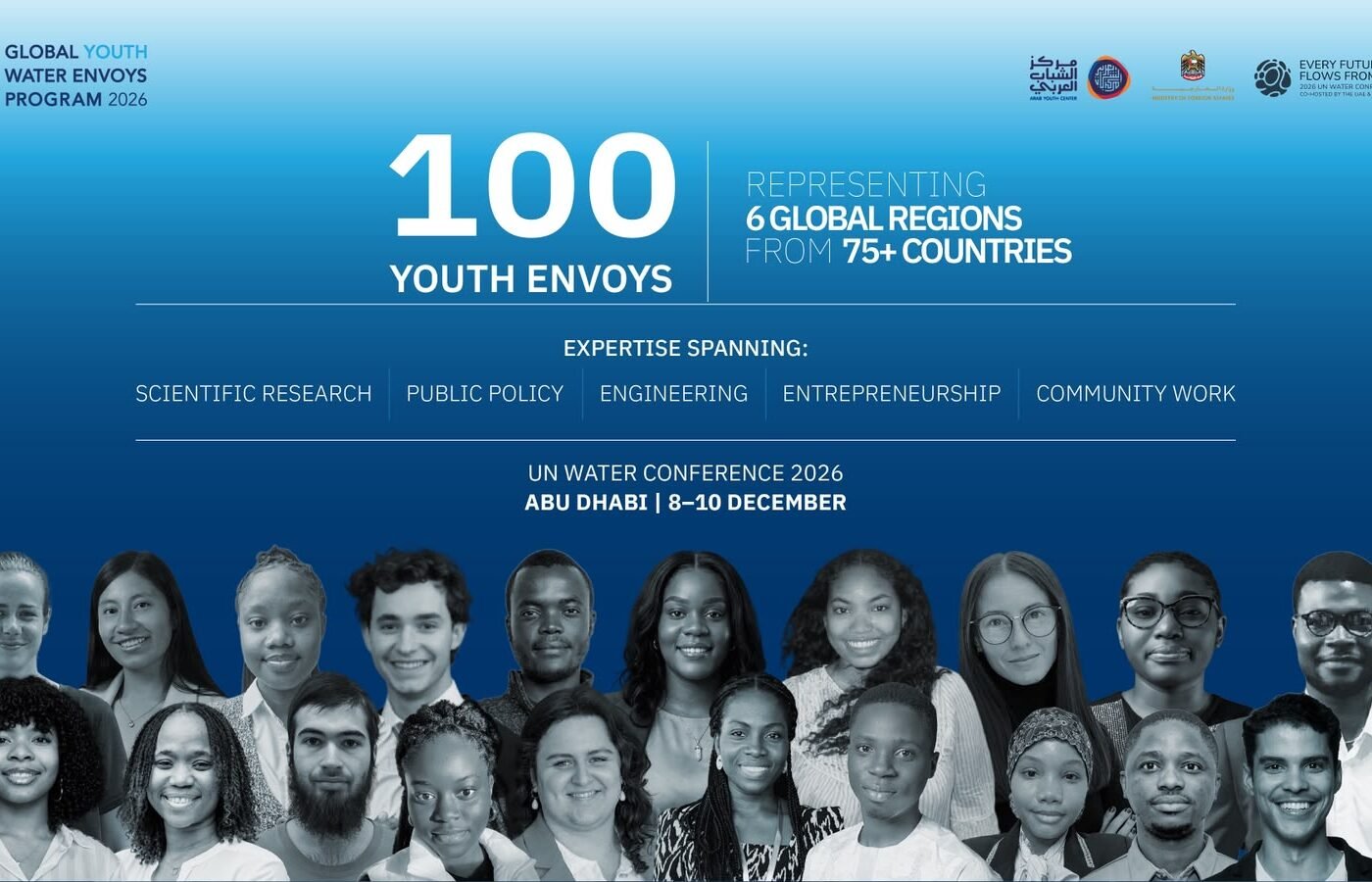
ABU DHABI: The Arab Youth Center (AYC) has announced the selection of 100 young leaders from 75 countries across six global regions as Global Youth Water Envoys. The cohort, chosen from over 2,000 applicants, will undergo two months of preparation to bring youth priorities and local water realities into discussions at the 2026 United Nations Water Conference.
The conference will be co-hosted by the United Arab Emirates and the Republic of Senegal in Abu Dhabi from 8 to 10 December 2026. The Envoys, who bring experience in research, public policy, engineering, entrepreneurship and community programmes, will take part in a structured learning journey during October and November. This will combine foundational training with specialised study aligned with the conference’s six Interactive Dialogues.
The cohort was formally welcomed during a virtual press conference and Welcome Ceremony. Opening remarks were delivered by H.E. Dr Sultan bin Saif Al Neyadi, UAE Minister of State for Youth Affairs and Vice Chairman of the Arab Youth Center, and H.E. Abdulla Balalaa, Assistant Minister of Foreign Affairs for Energy and Sustainability. Eng. Fatima Al Hallami, Executive Director of the AYC, presented the programme’s selection milestones and learning journey. Representatives of the programme’s enabling partners and two selected Envoys also addressed the gathering.
Launched by the AYC during the UN High-Level Political Forum in New York in July 2026, the programme is organised in strategic partnership with the UAE Ministry of Foreign Affairs and supported by the Children’s Investment Fund Foundation (CIFF), WaterAid and Green Youth Africa Organization. It aims to prepare young people to contribute to global water policy discussions and advance Sustainable Development Goal 6 on clean water and sanitation for all.
Addressing the selected Envoys, H.E. Dr Sultan bin Saif Al Neyadi said: “The Global Youth Water Envoys will attend the 2026 United Nations Water Conference as informed contributors, prepared to challenge assumptions and represent the realities of communities that are too often discussed without being adequately heard. The value of their participation will be defined by the knowledge they bring, the rigour of their preparation and their ability to translate experience into proposals that decision-makers can act upon. This programme reflects the UAE’s commitment to equipping young people to contribute meaningfully to international cooperation and influence the decisions that will shape their future.”
H.E. Abdulla Balalaa added: “With this program, the UAE is launching a platform where young leaders can deeply engage in global water diplomacy in a constructive and transformative way, towards the 2026 UN Water Conference and beyond. For too long, youth voices have been on the side lines, listening to speeches and taking notes. That ends now. We want you to speak your mind. We want you to challenge yourself. We want you to bring forward new ideas. And we want you to be part of the decision-making.”
The cohort spans six global regions, with representation from Africa, the Arab States, and Asia and the Pacific. Countries represented include Morocco, Jordan, Sierra Leone, Palestine, Indonesia, the Solomon Islands, Trinidad and Tobago, Bolivia and the Netherlands. The Envoys bring knowledge of hydrology, environmental law, engineering and water governance, alongside practical experience in public institutions, international organisations and community programmes. The group also includes founders developing water-related ventures.
Following an initial assessment of eligibility, shortlisted applications underwent a detailed review by an independent selection committee of 20 representatives from 12 leading partner organisations across the water and youth sectors. These included AJPEAS, GAYO, the International Secretariat for Water, IWA, the Latin America and the Caribbean Youth Parliament for Water, the UN Major Group for Children and Youth, UNEP, UNESCO, UNICEF, WaterAid, WaterAid Pan Africa, and the World Water Council.
The virtual learning journey will begin with foundational training before progressing into specialised tracks, supported by independent learning resources, practical work and coaching. Eng. Fatima Al Hallami said: “At the Arab Youth Center, our responsibility is to make this experience valuable for every envoy. We want you to understand how global water policy takes shape and where your expertise can contribute. The learning journey we have developed with Bon Education is designed around that purpose. We have placed practical application at the centre of this approach.”
Among the Envoys, Fatima Behzad Afghan from the UAE, who works on the planning and design of stormwater and wastewater infrastructure and serves as President of the Dubai Municipality Youth Council, said: “Attracting investment in water infrastructure requires clear frameworks that reduce risk and recognise the long-term value of resilient systems. I hope the conference advances public-private partnerships that support wastewater and stormwater projects, with water reuse and future growth built into national planning.”
Lissong Diop from Senegal, a PhD student researching how Earth observation and artificial intelligence can help assess water availability in the Ferlo pastoral region, said: “Making scientific data accessible can help more people contribute to water decisions. Earth observation offers valuable evidence, while pastoral communities bring knowledge rooted in experience. Through this program, I hope to explore how both can inform water governance.”
The Envoys’ learning and discussions will feed into six thematic youth statements and a consolidated Global Youth Water Statement. These outputs will bring together evidence, shared priorities and recommendations developed across the cohort in preparation for their conference contributions.
The Global Youth Water Envoys Program is organised and led by the Arab Youth Center in strategic partnership with the UAE Ministry of Foreign Affairs. CIFF, GAYO and WaterAid serve as enabling partners, with Bon Education supporting the programme’s learning design and capacity-building delivery.
Source: Press Release